The Map Is Not the Place: Common Errors in Reading Place Names
Learn how to read place names without mistaking spelling, pronunciation or old meanings for simple facts about the landscape and its past.
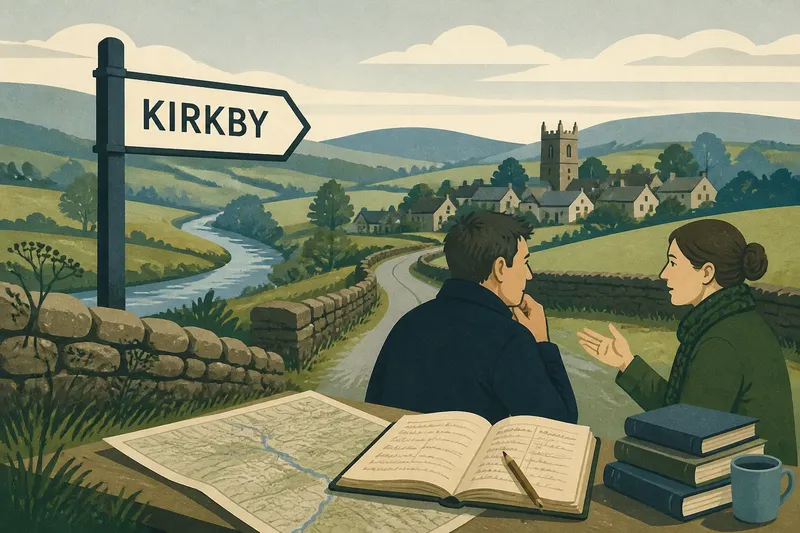
A road sign points toward a village called Kirkby, while a local speaker says something closer to “Kirby.” That small difference is a reminder that place names are not transparent labels: their spelling, sound and meaning have traveled through different hands. Reading place names well means treating them as clues, not as ready-made descriptions.
A name may preserve an older language, reflect a later spelling convention or have shifted in pronunciation while its written form stayed put. Even a seemingly familiar element can mean something different in a particular region. The useful question is not simply “What does this name mean?” but “Which version of the name, from which period, and according to whom?”
Does a place name have one obvious meaning?
No. A place name can have several plausible interpretations, and the evidence may not identify one with certainty. A familiar-looking word may be a modern spelling of an older form, while a supposed second element may have been reshaped to resemble an everyday word.
Consider a name that appears to contain “stone.” It might refer to a prominent rock, but it could also preserve a personal name or an older word whose sound later came to resemble “stone.” The modern spelling alone cannot settle the question. Earlier spellings, local geography and language history all matter.
It also helps to distinguish a name’s current sense from its origin. Speakers may understand a name through familiar words today even if those words had no part in its formation. That later interpretation can still be meaningful to local people, but it is not automatically the historical explanation.
Why can the spelling hide the original form?
Written forms change as clerks, mapmakers, sign makers and residents record names according to the conventions they know. A name first written in one language may later be adapted to another language’s spelling habits. Letters can be added, dropped or substituted, and spacing can shift as a name becomes standardized.
Old records are especially easy to overread. A parish register, estate document or early map may spell the same place differently from a later road map. That variation does not necessarily mean the place had several separate names. It may show that no single written form had yet become routine, or that a recorder was writing down what they heard.
Modern maps are useful for locating places and checking current official forms, but they are not dictionaries of origin. A map’s spelling is usually a practical label, not an explanation of the name’s history. To investigate an origin, compare records from different periods and pay attention to what each source was designed to record.
Why does local pronunciation differ from the map?
Pronunciation can preserve local speech patterns that a standard spelling does not represent. A place name may have sounds that are reduced, softened or combined in everyday conversation. Residents may also retain a local form while visitors and broadcasters follow the written spelling more closely.
Neither form is automatically the “correct” one for every purpose. An official spelling helps identify a place in records and on signs; local pronunciation tells you how people in the area commonly say it. If you are speaking with residents, listening and following their usage is usually more respectful than insisting that the letters dictate the sound.
Pronunciation is evidence, but it is not a complete origin story. A local spoken form may have changed over generations, just as written forms do. It can help narrow down possibilities, especially when compared with nearby names, but it should be considered alongside documentary forms and language context.
Can a name describe the landscape around it?
Sometimes, but the description may be indirect or refer to a landscape that has changed. A name can point to a hill, stream, wood or settlement feature, yet the relevant feature may be small, altered or no longer visible. The modern view from a road may not reveal the feature that mattered when the name took shape.
Names can also refer to relationships rather than a single object: a settlement beside a river, a farm associated with a larger estate, or a place distinguished from another with a similar name. A tempting landscape explanation should therefore be checked against older records and the pattern of neighboring names.
Imagine a fictional hamlet whose name appears to mean “willow bank.” A reader sees no willows beside the current road and rejects the interpretation. If older maps show a stream and wet ground nearby, and earlier spellings fit the relevant language, the description becomes more plausible; it still remains an interpretation rather than a certainty. The visible landscape is one part of the evidence, not the whole case.
How should you check a name before explaining it?
Start with the exact modern form, then look for older spellings in reliable local records. A county history, place-name reference work, archive catalogue or historical map can provide leads. For a northern place, a reference may discuss elements from Norse, Gaelic, Scots, English or another local language, depending on the area and its history.
Compare evidence rather than collecting attractive stories. An explanation is stronger when older forms, pronunciation, nearby names and the physical setting support one another. A single resemblance to a modern English word is weak evidence by itself.
- Record the current spelling. Note whether you are using a road sign, map, local authority record or another source.
- Look for earlier forms. Check whether the name appears in older maps, parish records or local archives.
- Listen to local speech. Ask how residents say the name, without assuming that their pronunciation must match the written form.
- Check the regional language context. See whether the proposed elements fit languages spoken in the area, rather than choosing a familiar modern word by appearance.
- Compare nearby names. Similar endings or repeated elements may reveal a regional naming pattern.
- Keep uncertainty visible. If sources disagree or the evidence is thin, describe the interpretation as possible rather than settled.
Say you are writing a short note about a fictional place called Brackenby. You find an old map with a different middle vowel, hear residents use a shortened pronunciation, and notice that nearby names share a similar ending. Rather than declaring that the name means “bracken farm,” you could explain that the modern spelling suggests that reading, while the older form and regional pattern need checking before the origin can be stated confidently.
Which questions help separate evidence from guesswork?
Does a familiar word inside a name prove its meaning?
No. The spelling may resemble a modern word because an older form was altered or reinterpreted over time. Look for earlier spellings and ask whether the proposed word fits the place’s language history.
Should the oldest recorded spelling be treated as the original?
Not necessarily. The earliest record you can find is only the earliest surviving evidence, and its writer may have recorded a spoken form imperfectly. Compare several records where possible rather than treating one spelling as definitive.
Is a local pronunciation more reliable than an official spelling?
They answer different questions: the official form identifies the place in current records, while local speech shows how people commonly say it. Neither alone establishes the name’s origin, so use both as distinct pieces of evidence.
What should you do when explanations conflict?
Set out the competing readings and say what evidence supports each one. If no explanation accounts for the spelling, speech and regional context more convincingly than the others, leave the origin open.
What makes a responsible explanation of a place name?
A responsible explanation separates what can be observed from what is inferred. You can state the current spelling, note a local pronunciation and point to an older recorded form. Then make clear whether the proposed meaning is well supported, plausible or uncertain.
That care does not make a name less interesting. It shows how a place carries several layers at once: a label used on maps, a sound shared in conversation and a history that may be only partly recoverable. The map gives you a starting point; the name becomes more legible when you ask how its written and spoken forms arrived there.
When explaining a place name, keep the evidence close to the claim. A cautious account that identifies its limits is more useful than a neat translation that hides them, and it leaves room for local knowledge to refine the story.