A Slow Look Around a Market Street
A slow look around a market street reveals how doorways, shopfronts, upper floors, and changing uses shape the town’s everyday character.
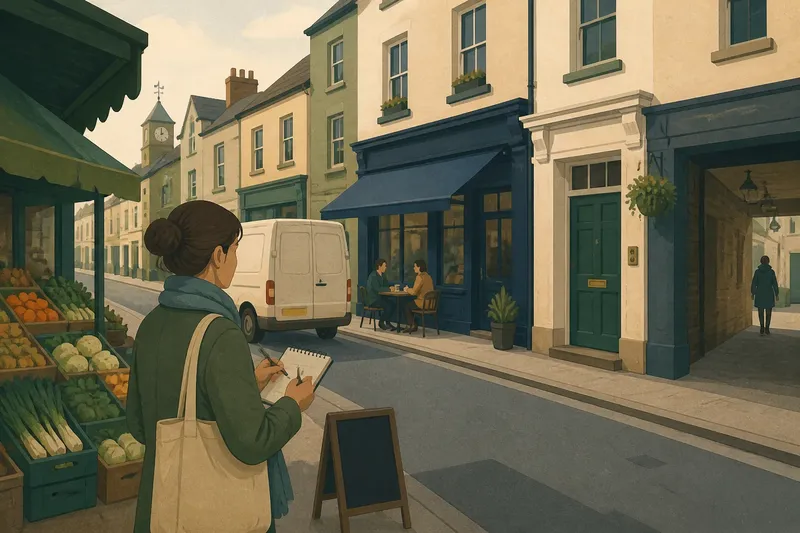
You pause outside a bakery on a market street, hoping to notice the buildings, but a delivery van blocks the view and the shop window pulls your attention back to the present. A slow look around a market street does not require a perfect view or a list of architectural claims. It works better as a walk with room for interruptions, where each feature offers a small clue about how the street is used.
Choose a route that leaves room to pause
A market street can be short enough to cross quickly and busy enough to make stopping feel awkward. Begin at one end and walk along a single side, then return along the opposite side if the street and footpaths allow. This gives you a simple sequence without turning the outing into a survey.
Choose a time when you can move at an easy pace. Market days may bring extra activity and temporary stalls; a quieter period can make upper floors and doorways easier to see. Neither is the right time for every purpose. Choose according to whether you want to notice the street in use or its quieter details.
If a pavement narrows or becomes crowded, keep moving and look from a place that does not obstruct anyone. A café window, public bench, or sheltered spot nearby can offer a better pause than standing in a doorway. The street is a shared space, not an exhibit arranged for a visitor.
When the street is too busy to observe, keep moving safely
What if delivery vehicles block the shopfronts?
Let the vehicle pass rather than trying to infer what is hidden behind it. Notice the neighboring frontage or return to that section on the walk back, when the view may have changed.
What if the pavement offers no comfortable stopping place?
Keep walking at an easy pace and take in features from the next clear stretch of pavement. If the street is crowded throughout, observe from a nearby public space instead of forcing a pause in the flow.
What if a shop window reflects more than it reveals?
Shift your viewing angle or look at the frame, doorway, sign, and wall around the glass. Reflections are part of the street’s present appearance, but they do not tell you what is inside.
What if a detail is difficult to identify?
Describe what you can see without assigning a date, former use, or architectural label. A plain note such as “narrow entrance beside a broad display window” preserves the observation while leaving the explanation open.
Read doorways as thresholds, not answers
Doorways show how people enter, leave, and separate one use from another. Notice whether an entrance sits directly on the pavement, opens into a recessed passage, or shares a frontage with a shop. Look for a bell, letter slot, step, or second door, but treat each as a visible feature rather than proof of a building’s history.
Some doors are in regular use; others may belong to an upper floor, service area, or space that is not open to visitors. A closed entrance can invite questions, but it cannot settle them. Do not try the handle or peer into private interiors. The useful observation is where the entrance sits in relation to the street and neighboring windows.
Follow the shopfront from pavement to upper floor
Shopfronts often draw the eye because their signs and displays change. Look beyond the goods: compare the width of the entrance with the display windows, notice where signs are fixed, and see whether one shopfront shares a continuous line with the next. A painted name may point to a current business; it does not by itself establish how long that business has occupied the site.
Then lift your gaze. Upper floors may have windows, shutters, separate entrances, or a different rhythm from the ground floor. This contrast can suggest that the street accommodates more than one kind of activity, though the exact arrangement may not be visible from outside. Keep the observation close to what is in view: “large ground-floor windows beneath smaller upper windows” is more useful than a confident guess about who lives or works there.
Signs, awnings, and temporary displays can hide parts of a frontage. Rather than treating that as a failed view, notice what has been added and where it changes the street’s appearance. A seasonal board or market stall is part of the street at that moment, even if it does not reveal the building behind it.
Notice how the street changes its use
A market street is not only a row of façades. Watch how people move between shops, where they wait, and whether a side lane, covered passage, or open corner draws foot traffic away from the main route. Listen for changes in sound between a busy frontage and a quieter stretch, without recording conversations or intruding on anyone’s privacy.
Imagine you begin beside a greengrocer whose crates narrow the pavement, then continue to a quiet doorway next to a café. You note that the first frontage brings activity close to the curb while the second offers a place to pause. The resulting note records a visible contrast without claiming that either business has always used the space that way.
Look for signs of shared use: a bench near a shop, a noticeboard, a place where customers gather, or a loading area that temporarily changes the pedestrian route. These details help explain the street’s everyday pattern without requiring a complete account of its past.
Keep notes that separate sight from inference
A short note can preserve a detail without interrupting the walk. Write down a recognizable location, what you observed, and what remains uncertain. A phone note or pocket notebook works; photographs can help later if taken from public space without blocking people or focusing on passersby.
- Check whether the feature is clearly visible, such as a recessed doorway; if it is, describe its shape, and if it is partly hidden, record only the visible portion.
- Check whether you can identify the location, such as beside a corner shop; if you can, include that landmark, and if you cannot, note the street section without guessing.
- Check whether your wording names an observation or an interpretation; if it describes something visible, record it plainly, and if it assigns a history or use, mark it as uncertain or leave it out.
- Check whether taking a photograph would keep you in public space and avoid focusing on passersby; if so, take a view of the frontage, and if not, use a written note or skip the image.
- Check whether a closer look would require entering private space or interrupting someone; if it would, keep your distance, and if the detail remains unclear, leave it unresolved.
- Check whether a sign, stall, or vehicle hides part of the frontage; if another clear viewpoint is available, look again from there, and if not, record what is visible rather than filling in the gap.
If a question still interests you after the walk, a local history display, library collection, or town archive may offer context. Keep that later information distinct from what the street itself showed you. A slow look around a market street is most rewarding when notes remain modest: they help you notice the next doorway, shopfront, or shift in use while leaving room for what one walk cannot establish.